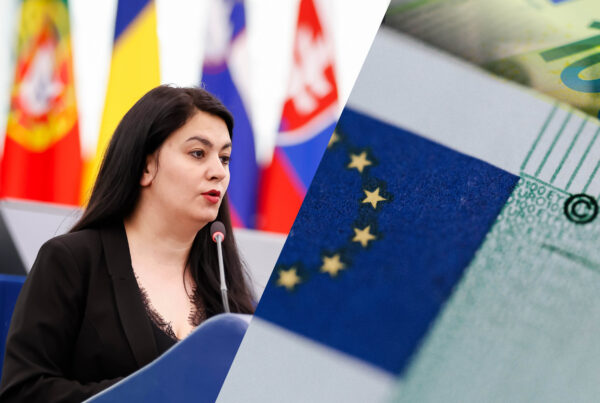

The COP31 meeting in Antalya has once again exposed the deep divisions within the international community over climate policy and the growing disconnect between the European Union’s climate ambitions and the economic and political realities of the rest of the world. ECR MEPs Anna Zalewska (PIS, Poland) and Michele Picaro (FdI, Italy) took part in the conference on behalf of the Group.
While the European Commission continues to push for ever more ambitious climate commitments, other major economies are increasingly unwilling to follow Brussels’ lead. The negotiations in Türkiye demonstrated just how limited the EU’s influence has become. Despite its efforts to secure stronger commitments, the EU struggled even to obtain agreement on including the word “clean” in the proposed global target to increase electricity’s share of final energy consumption to 35 per cent by 2035. The current state of negotiations suggests that the final agreement will fall far short of Brussels’ ambitions.
Anna Zalewska said:
“Once again, the European Commission arrived at a climate summit determined to lecture the rest of the world on the need for greater ambition, only to discover that other countries have very different priorities.”
“If the EU cannot even build consensus around the word ‘clean’ in a global electrification target, it should seriously reconsider its approach.
“Europe cannot continue imposing increasingly costly climate obligations on its own industries while its global competitors refuse to follow the same path.”
Other countries, including major economies, such as China and India, so far have resisted attempts to translate the proposed electrification pledge into a common negotiated commitment. The broader discussions, including Brazil’s distinct approach to the energy transition, have illustrated that countries are determined to safeguard their industrial competitiveness, energy security and economic development rather than automatically embrace the EU’s preferred model of decarbonisation.
At the same time, the EU’s negotiating position has been weakened by mounting budgetary pressures. For years, Brussels sought to secure stronger climate commitments by offering substantial financial assistance to developing countries. With European public finances increasingly constrained and governments facing competing spending priorities, the Commission has far less room to offer new financial commitments in exchange for greater climate ambition.
Michele Picaro said:
“The message from Antalya is clear: other countries are not prepared to sacrifice their industrial competitiveness and their citizens’ prosperity on the altar of climate ambition.”
“China, India and other major economies are defending their economic interests, while Brussels continues to behave as though the entire world should adopt the European Green Deal.
“At the same time, the EU is discovering that its financial resources are no longer unlimited. Without the promise of ever-increasing financial transfers, the Commission is finding it considerably harder to persuade other countries to endorse its climate agenda.”
Despite Commissioner Wopke Hoekstra’s efforts to present the negotiations positively, the Commission faces criticism from both sides. At home, left-wing political groups and environmental NGOs accuse it of failing to secure sufficiently ambitious commitments. Abroad, developing countries criticise the EU’s reluctance to provide additional climate finance.
These competing demands leave the Commission pressing its partners for greater ambition while facing limits on the political and financial support it can offer.
COP31 should be a wake-up call. Europe cannot shape the global climate agenda through unilateral regulation and increasingly ambitious targets alone. Its climate policy must reflect economic realities, ensure affordable and secure energy, and protect industrial competitiveness.
The ECR approach rests on three principles:
The first is technological neutrality. The objective should be clear – gradual reducing emissions – while innovation and research should determine the most effective ways to achieve it. Renewables are essential, but so are biofuels, hydrogen, carbon capture and, above all, nuclear power, which provides stable, reliable and low-emission energy. Without nuclear power, the transition will be more costly and less effective.
The second is energy security. Recent crises have shown that climate and energy policy cannot be treated separately. A transition that replaces Europe’s dependence on energy imports with dependence on imported technologies and critical raw materials, thereby making it more vulnerable, cannot be considered a success.
The third is competitiveness and reciprocity. Europe accounts for only a small share of global emissions. It can lead by example only if it shows that decarbonisation and economic growth can go hand in hand – and if major emitters do their part. European businesses should not bear ever-increasing costs while their competitors, sheltering behind the outdated label of “developing countries”, continue to increase emissions.
Europe cannot afford to be the only major economy imposing ever-growing costs on its industries in pursuit of climate objectives that the rest of the world is unwilling to share.