
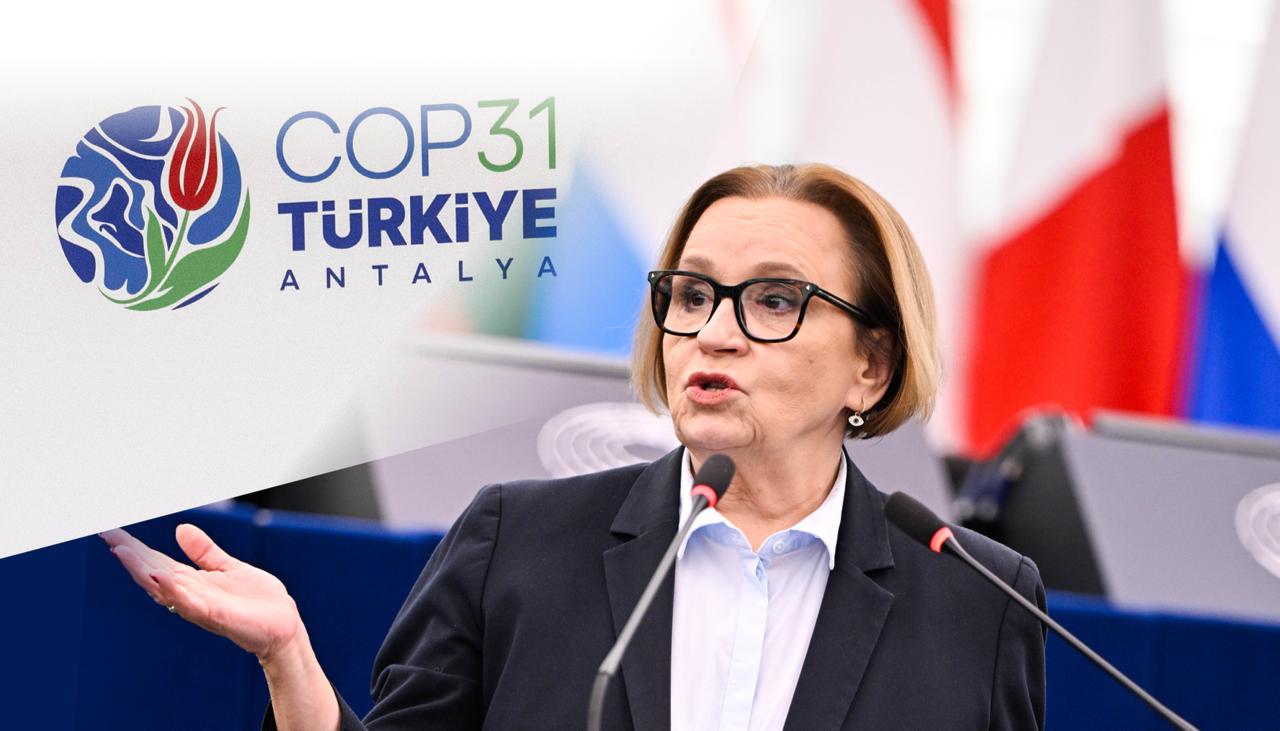
The outcome of COP31 in Antalya should prompt a reassessment of the EU’s climate policy in light of dwindling financial resources and the lack of international support for its ambitions, ECR ENVI Deputy Coordinator Anna Zalewska told the European Parliament during Thursday morning’s debate. She stressed that these realities must be reflected in the EU’s next Multiannual Financial Framework for 2028–2034.
Zalewska, who attended COP31 on behalf of the ECR Group, said:
“This is not an impression, it is not an opinion, it is a fact: The European Union stands alone with its climate ambitions. Once again, it has failed to convince the world that it is right.”
She pointed to Europe’s diminishing ability to secure international support for its climate agenda through financial commitments. She said:
“Western countries arrived without strong financial mandates. Our resources are running out. More and more countries are in dire straits and facing the threat of public finance bankruptcy. The same is happening to the European Union. The world can openly see this. It says: ‘You want to do this, we want to do this. But who’s going to fund it?’”
As an example of Europe’s isolation, Zalewska highlighted the difficulties in persuading China to accept greater responsibility for global climate efforts, despite its economic strength.
“I recall a conversation with the Chinese, whom we tried to convince that it was high time to revise the list of developing and developed countries, because, after all, the Chinese are an economic powerhouse,” she said.
Despite its economic strength, China, she explained, maintains that it is still a developing country, while viewing its production of raw materials and clean technologies on which Europe depends as its contribution to global climate efforts.
“On rare-earth metals, on their solar panels, wind farms, and on their electric cars. That is, after all, how they understand contributing to the realisation of climate ambitions”, Zalewska said.
Even on electrification, Zalewska pointed out, it proved impossible to reach agreement on a commitment to clean energy sources, given the different economic circumstances and technological capabilities of countries around the world.
“And finally, electrification, because this was indeed something we cared deeply about. You’ll recall that we concluded that electrification is indeed the way forward, but not from clean sources,” she said.
Zalewska called for an urgent reassessment of European climate policy as part of the negotiations on the next long-term EU budget, saying:
“It is time for reflection, time to take stock of our climate ambitions. We need to start doing this right from the outset when drawing up the budget for the coming years.”